CROS Hearing Aids: Solutions for Single-Sided Hearing Loss
Living with single-sided deafness can be challenging. CROS technology restores your sense of 360° sound, capturing audio from your poorer ear and transmitting it to your good ear. This simple, life-changing solution helps you engage in conversations, feel safer, and reduce daily listening effort.
Schedule a Free Hearing TestKey Takeaways
- Restores 360° Sound: CROS systems pick up sound from your non-hearing side, ensuring you don't miss conversations or environmental cues.
- Improves Speech Understanding: By reducing the "head shadow" effect, CROS makes it easier to follow conversations, especially in noisy places like restaurants.
- Enhances Safety: Greater sound awareness helps you detect the direction of traffic, approaching footsteps, and other important alerts.
- Two Main Types: A CROS system is for one deaf ear and one good ear. A BiCROS system is for one deaf ear and a better ear that also has hearing loss.
- Modern & Discreet: Today's CROS devices are small, comfortable, and available in rechargeable models with Bluetooth streaming capabilities.
- Personalized Solutions: A comprehensive hearing evaluation is crucial to determine if a CROS or BiCROS system is the right solution for your specific needs.
Overview of CROS Technology
A CROS (Contralateral Routing of Signal) hearing aid is a specialized, non-surgical system designed for individuals who have significant hearing loss in one ear and normal or near-normal hearing in the other. This condition, known as single-sided deafness (SSD) or unilateral hearing loss, affects millions of people and presents unique challenges that traditional hearing aids cannot solve.
Living with SSD often means constantly turning your "good" ear towards sounds, struggling to locate where sounds are coming from, and feeling exhausted from the effort of listening. It can make conversations in groups, business meetings, or noisy environments incredibly difficult. At Ear to Hear, we specialize in fitting CROS and BiCROS systems to help patients overcome these obstacles, dramatically improving their safety, communication, and overall quality of life.
The core purpose of a CROS system is not to make the deaf ear 'hear' again, but to provide the brain with the auditory information it's been missing. By wirelessly routing sound from the deaf side to the hearing ear, it effectively restores a 360-degree awareness of the soundscape around you.
Our Process for a Better Hearing Experience
1. Free Hearing Evaluation
Your journey begins with a comprehensive, no-obligation hearing assessment. We'll precisely map your hearing ability in both ears to determine if you are a candidate for a CROS or BiCROS system.
2. Personalized Fitting
Based on your evaluation, we'll recommend the best CROS device for your lifestyle and needs. We then program the device, ensuring it's perfectly tuned for comfort and optimal sound quality.
3. Ongoing Support & Care
We provide continuous support as you adapt to your new way of hearing. Our care includes follow-up adjustments, cleaning, and any assistance you need to get the most from your CROS system.
How a CROS System Works
The principle behind CROS hearing aids is brilliantly simple yet technologically advanced. The system consists of two parts that communicate seamlessly to deliver a full spectrum of sound.
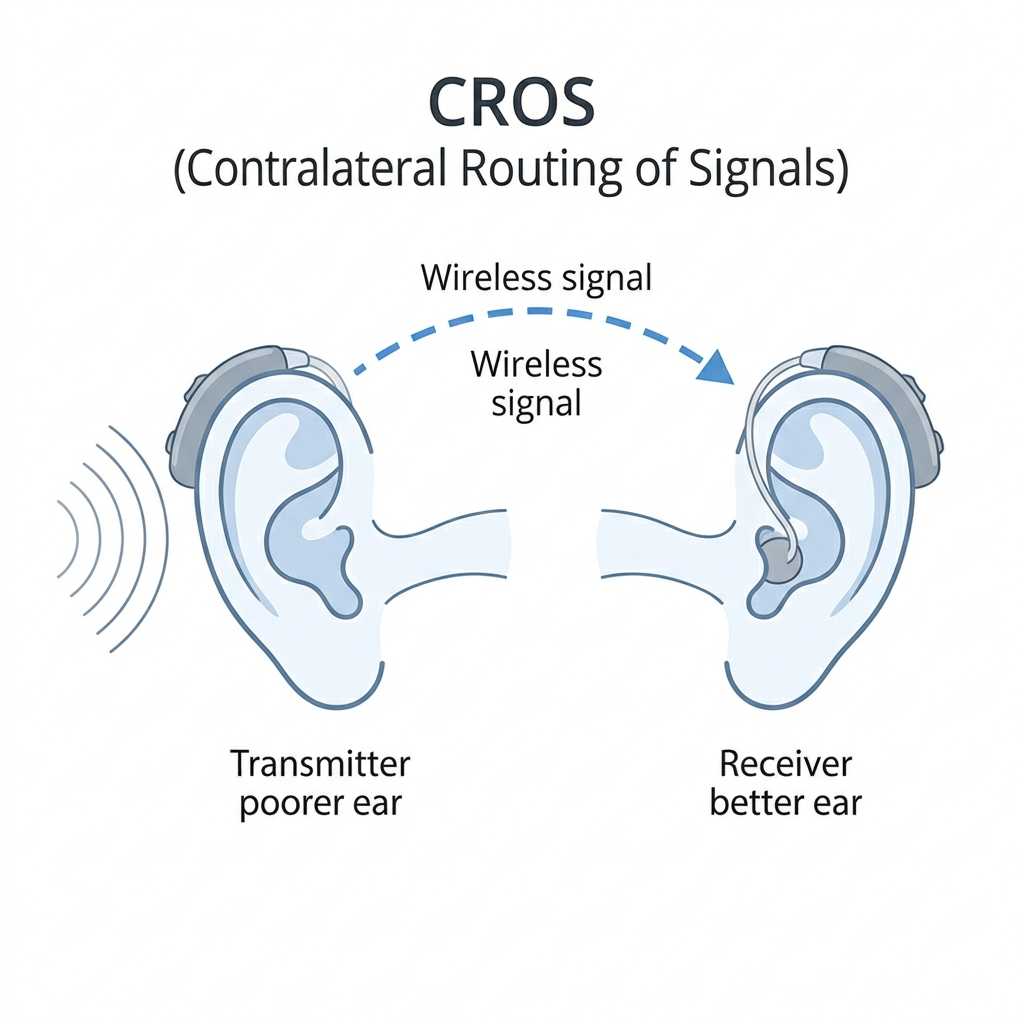
- Microphone and Transmitter: A discreet device is worn on the ear with poor or no hearing. It looks like a standard hearing aid but its sole job is to house sophisticated microphones that pick up sounds from that side. These sounds are instantly converted into a digital signal.
- Wireless Signal Transmission: Using advanced, low-energy wireless protocols, the transmitter sends this digital audio signal in real-time across to the other ear. This transmission is instantaneous and lossless, meaning the sound quality is clear and without delay.
- Receiver: A second device, worn on the 'good' ear, receives the wireless signal and plays the transmitted sound into your ear canal. This receiver looks like an open-fit hearing aid, ensuring that it doesn't block the natural hearing of your good ear. Your brain then processes the sound as if it's naturally coming from that side.
This entire process happens in milliseconds, allowing your brain to integrate the audio from both sides naturally. This helps overcome the "head shadow" effect, where your head physically blocks sounds from reaching your good ear, a primary challenge for those with single-sided deafness.
CROS vs. BiCROS: What's the Difference?
Understanding the distinction between CROS and BiCROS is key to finding the right solution. The choice depends entirely on the hearing ability of your "better" ear.
CROS (Contralateral Routing of Signal)
A CROS system is the designated solution for individuals with:
- One unaidable ear: An ear with profound hearing loss or deafness.
- One ear with normal hearing: The "good" ear has hearing thresholds within the normal range.
In a CROS setup, the device on the good ear acts only as a receiver. It does not amplify sounds for the good ear.
BiCROS (Bilateral CROS)
A BiCROS system is designed for individuals who have:
- One unaidable ear: Same as with a CROS system.
- One ear with hearing loss: The "better" ear also has a level of hearing loss that requires amplification.
The device on the better ear is a hybrid: a receiver for the CROS signal and a standard hearing aid for that ear.
Key Features of Modern CROS Systems
Today's CROS devices are packed with technology to make your hearing experience as natural and convenient as possible. Here are some of the key features you can expect from leading brands like Phonak and Signia.
| Feature | Description |
|---|---|
| 360° Sound Detection | Advanced directional microphones on the transmitter focus on speech and sound from all directions, ensuring you are aware of your total environment. |
| Bluetooth® Streaming | Directly stream phone calls, music, podcasts, and TV audio from your smartphone or other compatible devices into your better ear. |
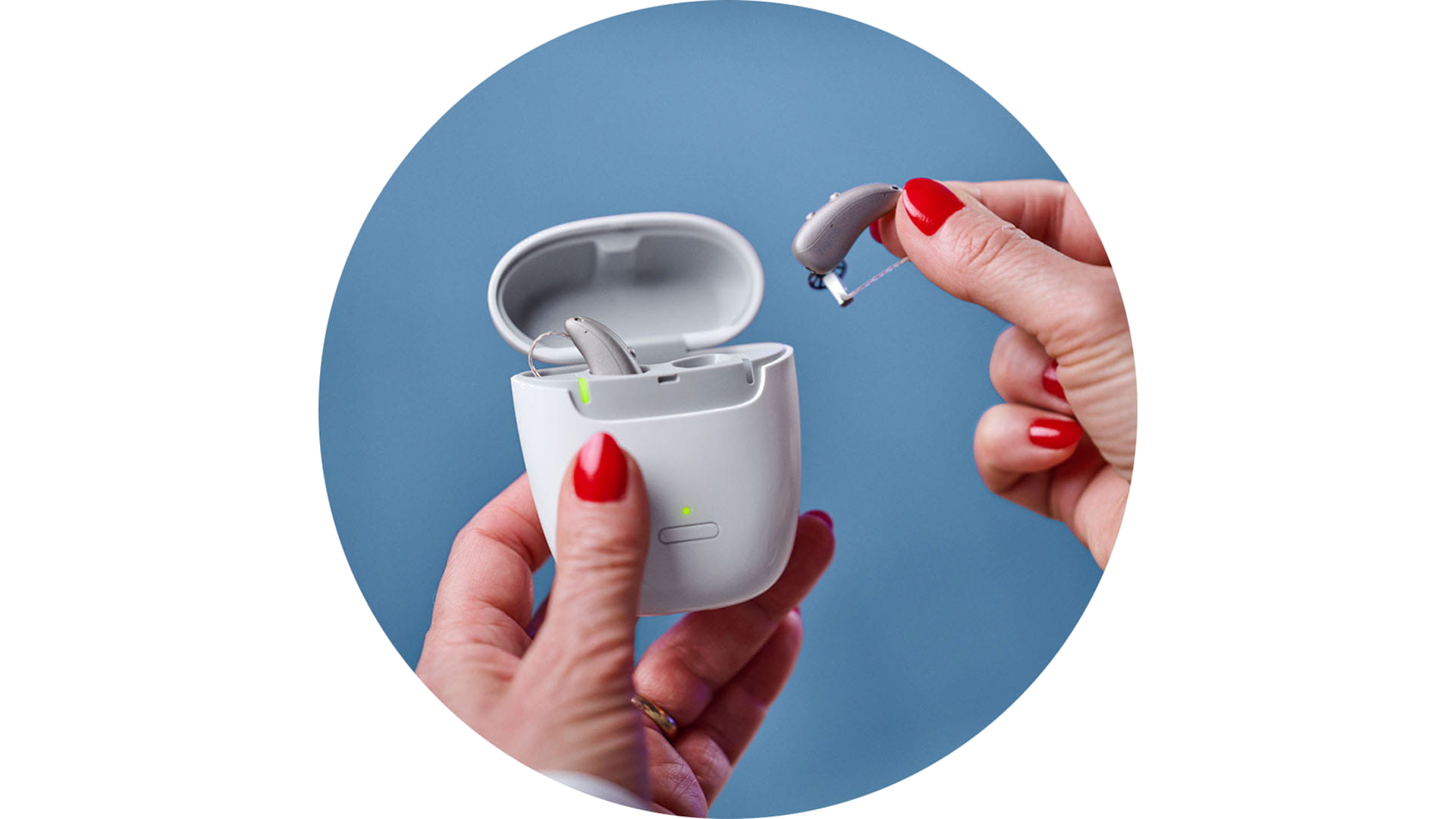
| Rechargeable Batteries | Enjoy a full day of hearing on a single charge. Simply place the devices in their portable charging case overnight for hassle-free power. |
| Advanced Noise Reduction | Sophisticated algorithms identify and reduce background noise while focusing on and enhancing speech, improving clarity in challenging environments. |
| Discreet, Comfortable Designs | Modern CROS systems are small, lightweight, and available in various colors to match your hair or skin tone for a near-invisible look. |
| Automatic Adaptation | The devices automatically sense your listening environment and adjust settings for the best performance. |
| Smartphone App Control | Discreetly adjust volume, change programs, and fine-tune your settings using an intuitive app on your smartphone. |
| Tinnitus Therapy | Many CROS systems include built-in tinnitus noise generators that provide sound therapy to help manage ringing in the ears. |
Watch: CROS Hearing Aids Explained
Who Can Benefit from CROS Hearing Aids?
If you experience any of the following challenges due to single-sided hearing, a CROS or BiCROS system could be a life-changing solution:
- Difficulty hearing people on your non-hearing side.
- Struggling to follow conversations in noisy environments like restaurants or cars.
- Feeling unsafe because you can't tell which direction sounds are coming from.
- Feeling tired or stressed from the effort of listening all day.
- Frequently having to turn your head to position your "good" ear towards a speaker.
Solution Comparison
| Solution | CROS Hearing Aid | Traditional Hearing Aid | Bone Conduction Implant |
|---|---|---|---|
| Best For | Single-Sided Deafness (SSD) | Bilateral Hearing Loss | SSD or Conductive Hearing Loss |
| Surgical | No | No | Yes |
| Routes Sound to Good Ear | Yes | No | Yes (via bone) |
| Discreetness | High (Behind-the-ear) | Varies (incl. invisible) | Moderate (external processor) |
| Bluetooth Streaming | Yes | Yes | Yes |
| Trial Period | Yes (Risk-Free) | Yes (Risk-Free) | No |
CROS Brands We Offer
We work with the world's leading manufacturers to provide the most advanced and reliable CROS technology available.
Signia CROS
- Features the advanced IX (Integrated Xperience) platform.
- Available in discreet RIC (Styletto, Pure) and BTE styles.
- Offers rechargeable options with portable charging cases.
Phonak CROS
- Powered by the Lumity and Paradise platforms.
- Known for excellent performance in noise and universal connectivity.
- Includes rechargeable models like CROS P-R and CROS L-R.
Frequently Asked Questions
A CROS (Contralateral Routing of Signal) hearing aid is a system for people with effectively no hearing in one ear (single-sided deafness). It uses a microphone on the poorer ear to pick up sound and wirelessly transmit it to a receiver on the better-hearing ear. This allows the user to perceive sounds from their deaf side, creating a sense of hearing from all directions.
A CROS system is for someone with one 'dead' ear and one ear with normal hearing. A BiCROS system is for someone with one 'dead' ear and a better ear that also has hearing loss. In a BiCROS setup, the device on the better ear is a fully functional hearing aid that both receives the signal from the other side and amplifies sound for that ear.
Individuals with unilateral hearing loss (single-sided deafness), where one ear has little to no usable hearing and the other ear has normal or near-normal hearing, are ideal candidates for a CROS system. This helps overcome the head shadow effect, improving awareness and speech comprehension.
Yes, most modern CROS systems from brands like Signia and Phonak feature Bluetooth connectivity. This allows you to stream phone calls, music, podcasts, and other audio from your smartphone or other compatible devices directly to the receiver on your good ear.
Yes, leading manufacturers like Signia and Phonak offer rechargeable CROS systems. These devices typically provide a full day of use on a single charge and come with a convenient charging case, eliminating the hassle and expense of disposable batteries.
The adjustment period varies for each individual. Some users adapt within days, while for others it may take several weeks. The brain needs time to learn how to process the new auditory information being routed from the non-hearing side. Consistent daily use is key to faster and more effective adaptation. Our audiologists provide guidance and support throughout this process.
References
- American Academy of Audiology. (n.d.). *Unilateral Hearing Loss*.
- Bagatto, M., et al. (2019). *The impact of CROS/BiCROS in adult hearing aid users*.
- Phonak. (2023). *CROS P: The smart solution for unilateral hearing loss*. Sonova AG.
- Signia. (2024). *CROS Solutions for single-sided hearing*. WS Audiology.
- Van de Heyning, P., et al. (2016). *Toward a unified testing and reporting framework for single-sided deafness studies: A consensus paper*.
Get a 7-Day Risk-Free Trial on Hearing Aids
Ear to Hear offers a 7-day risk-free trial on hearing aids. Give yourself the opportunity to try hearing aids in any environment, risk-free. With 14 locations across Florida, Illinois, and Missouri, our friendly team is ready to help you find the right hearing aid.
Free 7-Day Trial